
Services
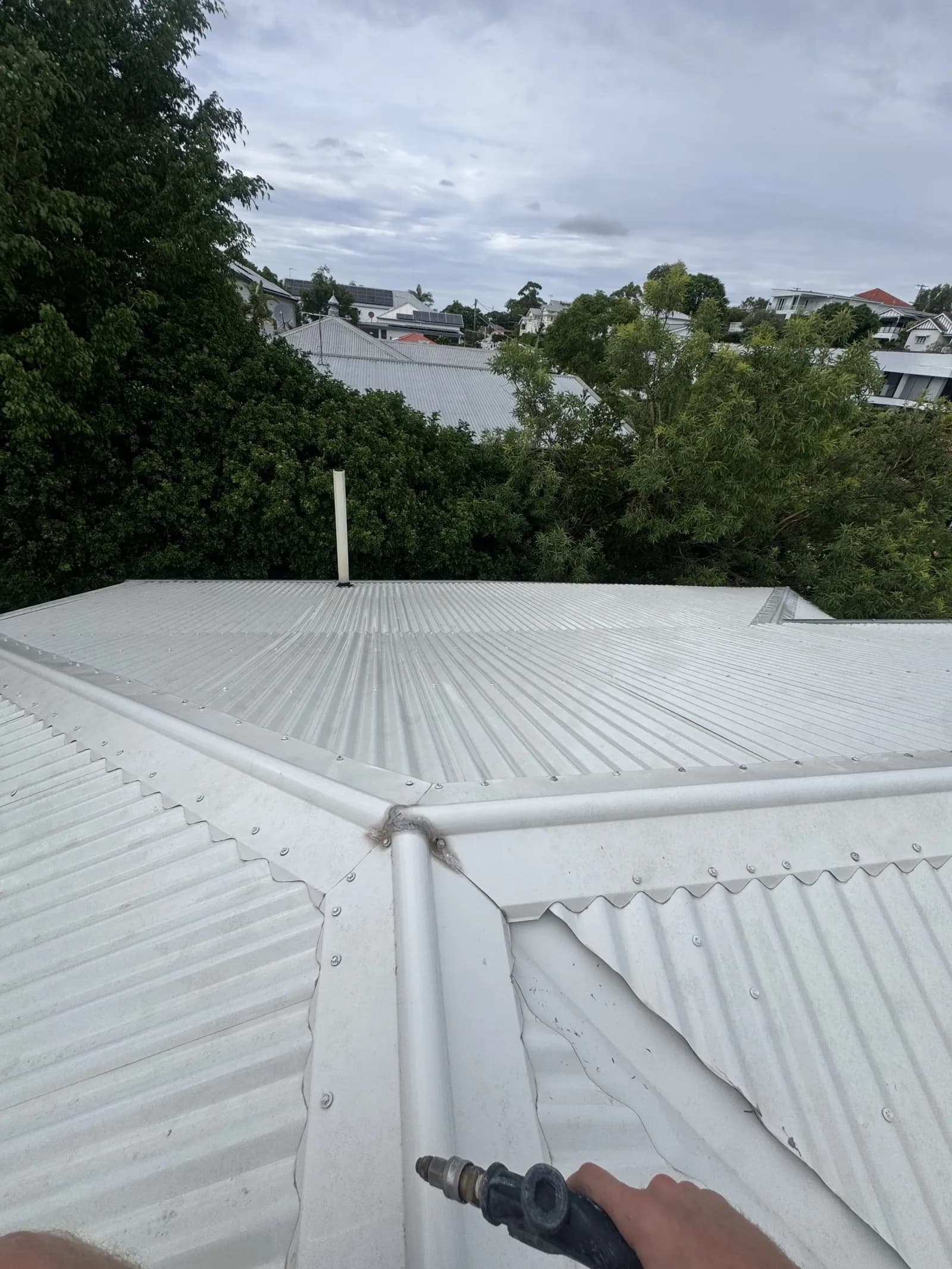
Roof Washing
Restore your roof's appearance and extend its life by removing lichen, moss, algae, and built-up grime.
Brisbane's subtropical climate is brutal on roofs. Lichen, moss, and algae take hold within months of a roof being installed, trapping moisture against tiles and sheeting and accelerating deterioration. Lichen in particular is a problem on terracotta and concrete tiles because the rhizines (the root-like attachments) penetrate the porous tile surface, so even after the visible green is dead, the structural damage can persist. Roof washing in Brisbane should not be a high-pressure jet down the slope; it should be a chemistry-led soft wash that kills the organic material at the source and slows regrowth with a post-treatment biocide. We do roof washing this way on every roof, whether tile, Colorbond, or concrete.
Why high pressure is wrong for tile roofs
Concrete and terracotta tiles have a protective surface coating applied at manufacture (pigment, sealant, or both) that gives the tile its colour and water resistance. High-pressure washing strips this coating, which leaves the tile body exposed to UV and water ingress, accelerating wear. Lichen rhizines also penetrate this coating layer, so removing lichen by force pulls the coating off with it. Soft wash uses a biocide solution that kills the lichen and algae at the cellular level, dwells for 20 to 40 minutes, then rinses off cleanly without touching the protective coating. The roof keeps its sealed finish and the lichen is genuinely gone rather than just visually removed.
Soft wash chemistry for roofs
Roof soft wash uses a stronger sodium hypochlorite concentration than house wash, typically 4 to 8 percent, because lichen and moss have a thicker cell wall than the surface mould on walls. We pair it with a surfactant designed to cling to sloped surfaces so the solution does not run off before it can work. Dwell time is longer than a house wash, around 20 to 40 minutes, and we re-treat heavily affected sections rather than trying to do everything in one pass. The post-wash biocide treatment is a residual chemistry that suppresses regrowth for 18 to 24 months by preventing spores from germinating on the freshly cleaned surface.
Tile, Colorbond, concrete, decramastic: by roof type
Terracotta tiles need the most cautious approach because the surface is porous and the pigment is integral to the colour. Heavy lichen can leave a faint shadow on terracotta after cleaning where the rhizines penetrated deeply. Concrete tiles are more robust and handle slightly higher pressure, but we still avoid raw high pressure on the tile body. Colorbond responds excellently to soft wash because the colour-bonded paint finish is sealed and chemistry-resistant. Colorbond roofs typically come up like new. Concrete decramastic roofs (the chip-coated style common on 1960s-70s homes) need the gentlest approach because the chip surface can be dislodged by pressure. Slate roofs are uncommon on Brisbane homes but when we encounter them we use the lowest pressure and a neutral chemistry to avoid affecting the slate finish. Trapezoidal corrugated iron and standard galvanised sheeting both clean well with soft wash. Older galvanised that has started to rust along the seams gets a degreaser pre-treatment but the rust itself we cannot reverse. We will tell you upfront if the rust is a structural concern rather than cosmetic.
Lichen vs moss vs algae: what's actually growing
Lichen is a symbiotic organism: a fungus growing in partnership with an alga. It appears as round or branching grey-green crusty patches and grows extremely slowly (a few millimetres per year). On Brisbane roofs it usually first appears on the south and west slopes that miss direct sun. The rhizines anchor into the tile pores, which is why force removal pulls coating off with it. Soft wash chemistry breaks the symbiotic relationship and kills both organisms at once. Moss is a simple non-vascular plant that grows in moist patches: around screws, in valleys, under overhanging trees. It is faster-growing than lichen but more easily removed because the anchoring is shallower. Algae is single-cell organisms that form the flat black or dark green staining streaking down slopes. Algae is mostly cosmetic but is a strong signal the roof is staying damp for too long, which means lichen and moss will follow if untreated. All three respond to soft-wash chemistry; lichen takes the longest dwell and the most thorough treatment.
Access, safety, and walking on tiles
Most tile roofs from the 1970s onwards are strong enough to walk if you know where the rafters are. We use soft-soled boots, walk on the lower edges of tiles where they overlap with their neighbour, and avoid the ridge caps and valleys. Steep pitches require harness work, which adds setup time but is non-negotiable for safety. Where access is impossible (decramastic roofs we will not walk, very steep pitches, fragile tiles) we work from a ladder, an extension wand, or a long-reach pole. We never compromise on roof access safety. A slip on a roof is one of the most serious accidents in our trade. Properties with double-storey or steep pitch get an access surcharge that we disclose in the quote, typically 15 to 25 percent on the base figure.
What to expect on the day for a roof clean
Roof cleans are full-day jobs on a single-storey home, two-day jobs on a larger or steeper property. We arrive with the truck-mounted system, an extension ladder, harnesses if needed, and the chemistry mix already prepared. The first 30 minutes is setup: protecting downpipes (so chemistry does not pool into them), pre-wetting plants and beds, and walking the roof to plan the sequence. The clean itself is two phases: chemistry application from the bottom up across the whole roof, then a long dwell (20 to 40 minutes) while we set up the rinse, then top-down rinse on a careful schedule so no section dries before being rinsed. After the rinse, the biocide post-treatment is sprayed lightly and left on. Gutters are flushed after to confirm the rinse moved through cleanly. Total time on-site is usually six to eight hours for a single-storey roof. You can be home or out, and most customers leave us to it.
Recommended cadence by roof type and suburb
Tile roofs in Brisbane benefit from a clean every 2 to 3 years. Suburbs with heavy tree canopy (Bulimba, Carindale, Belmont, Kedron) trend toward the 2-year end because lichen pressure is higher. Open-canopy suburbs (Aspley, Mansfield, Sunnybank Hills) can stretch to 3 years. Colorbond roofs need a clean every 3 to 5 years because the sealed finish prevents lichen from anchoring as deeply. Bayside roofs (Wynnum, Manly) need attention every 2 years regardless of material because salt accelerates the surface staining. We send a reminder when each customer is approaching their next recommended clean.
DIY roof cleaning: why we don't recommend it
Roof work is the highest-injury area in trades and DIY cleaning. The risks are not just a slip and fall (although that is the main one). The second risk is the technique itself: high-pressure DIY cleaning strips the tile coating, which accelerates the deterioration the customer was trying to prevent. The third is the chemistry. Consumer-grade roof-clean products are weaker than commercial chemistry and often need multiple applications, with each application increasing the chance of run-off into the wrong places. The fourth is the biocide post-treatment; without it, lichen returns within months. If you are confident on a roof and you have the right access equipment, DIY is possible for light algae. For anything involving lichen, moss, or any tile roof older than 10 years, the professional call is the right one. The cost difference is not large; the safety difference is.
Roof cleaning vs roof restoration
Roof cleaning is what we do: soft-wash removal of growth and grime, with a biocide post-treatment. Roof restoration is a different trade involving repainting or resealing the tile surface, typically by a roofing contractor. The two are sometimes confused because the visual result of a restoration is even more dramatic than a clean. A clean returns the roof to its existing surface condition. A restoration adds a new coating layer. If your roof is sound and the lichen/moss is the issue, cleaning is the right job. If the tile coating is failing (chalking, pitting, faded irregular colour), restoration may be the better call. We can recommend a roof restorer if you need one after the clean. We work alongside several in Brisbane.
What's included
- Soft-wash technique safe for tile, Colorbond, and concrete roofs
- Lichen, moss, and algae removed at the source, not just surface
- Post-wash biocide treatment to slow regrowth for 18-24 months
- Restores original colour without stripping tile surface coating
- Includes pre-wet plant protection and runoff management
- Gutter clearing available as an add-on in the same visit
- Before-and-after photos with every job
Typical pricing
Roof washing in Brisbane starts at $900. Price scales with roof size, pitch, tile type, and lichen load.
All prices include GST. Quotes are fixed: what we quote is what you pay. See full pricing reference →
Roof Washing by suburb
Detailed roof washing guidance for the suburbs we work in most often. Each page covers local housing stock, common concerns, and pricing notes specific to that area.
Roof Washing Belmont
4153Lichen on tile roofs and mould on rendered south-facing walls
Roof Washing Carindale
4152Mould on shaded render walls and eaves accumulating debris from overhanging trees
Roof Washing Mansfield
4122Set-in mould on older brick walls and weathered concrete tile roofs
Roof Washing Bulimba
4171Mould on shaded heritage timber and algae build-up on river-facing walls
Roof Washing Wynnum
4178Accelerated algae on weatherboard and oxidation of Colorbond roofs
Roof Washing Mount Gravatt
4122Heavy lichen and moss on older terracotta tile roofs
Roof Washing Sunnybank
4109Set-in mould on older brick walls and grime on units near the shopping precinct
Roof Washing Manly
4179Accelerated surface wear on every exterior, plus copper and brass detail care
Frequently asked questions
Will the roof clean damage my tiles?
No. We use soft-wash chemistry rather than high pressure on the tile surface, so the protective coating and the tile body are not disturbed. High pressure can strip tile coatings and is not used on roofs in our process.
How long does a roof clean last?
The visible result lasts indefinitely because the lichen and moss are dead. The biocide post-treatment suppresses regrowth for 18 to 24 months, after which the suburb's canopy and humidity start the cycle again. Most customers re-book every 2 to 3 years.
Will the roof clean discolour my gutters or walls?
No. Soft-wash chemistry rinses cleanly off Colorbond, aluminium, and galvanised gutters. The runoff is rinsed through with plain water and the chemistry does not stain wall surfaces below.
Can you do roof and house wash in one visit?
Yes, on a single-storey home. We start with the roof so its rinse becomes part of the wall pre-wet, then move on to the house wash. The full sequence takes 6 to 8 hours. Larger homes are usually split across two visits.
What is the difference between roof cleaning and roof restoration?
Roof cleaning is what we do: soft-wash removal of growth and grime, with a biocide post-treatment. Roof restoration is a different trade involving repainting or resealing the tile surface, typically by a roofing contractor. We can recommend a roof restorer if you need one after the clean.
Do you walk on the roof or work from a ladder?
Depends on the roof. Most tile roofs from the 1970s onwards we walk with soft-soled boots, staying on the tile overlaps and away from ridges. Steeper pitches we work in a harness. Decramastic and fragile roofs we work from ladder, extension wand, or pole only.
Other services
Get a free quote
Tell us what you need cleaned and we'll get back to you with a quote within 24 hours.
Service info
- Type
- Roof Cleaning
- Coverage
- Greater Brisbane
- Insured
- Yes
- Rating
- 5.0 ★ (18 reviews)
Free quote, same day
Ready to see the difference?
Send us your address. We'll have a quote back to you within hours — honest price, no obligation.